


Description
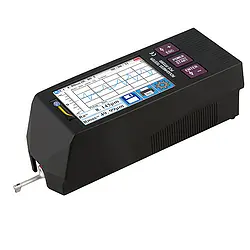
Surface Testing – Roughness Tester PCE-RT 2300
Portable material tester for the rapid detection of roughness (Ra, Rz, Rq, Rt and many more) / Detachable motor unit / Touch screen Interface / 320 μm or 12.6 mil range
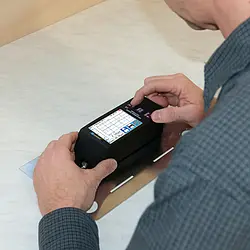
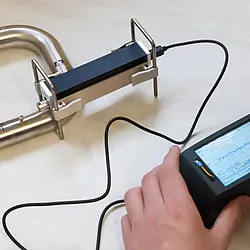
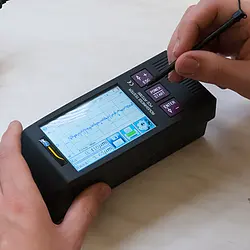
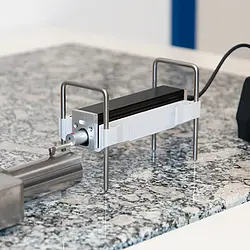
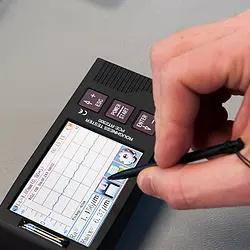
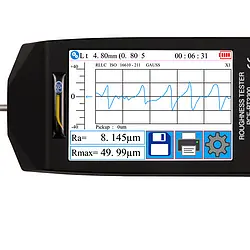
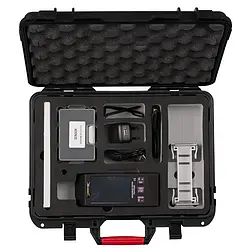
The surface testing – roughness tester PCE-RT 2300 is used to measure the roughness of surfaces. The PCE-RT 2300 roughness meter has a removable motorized sensor, allowing it to measure the surface roughness even on small or narrow profiles. The measured values are displayed on a large LCD display. The roughness tester is powered by an internal battery or a USB power adapter.
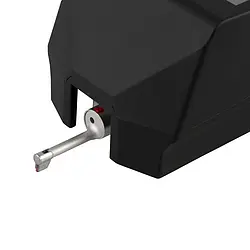
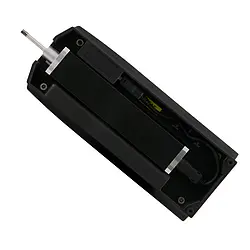
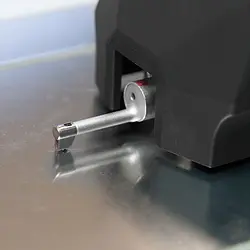
The detachable motorized sensor is connected by a cable to the main unit of the roughness gauge. The diamond stylus is installed in the motorized sensor, applying a maximum force of 4 mN on the surface being measured. The roughness tester measures according to ISO, ANSI, and JIS standards for roughness measuring instruments.
Worth knowing about the roughness measuring device:
Rz = average roughness
The mean roughness depth Rz is the arithmetic mean of the largest individual seam depths of several adjoining individual measuring sections.
Ra = arithmetic mean roughness
Ra is the internationally recognized roughness parameter. It is the arithmetic mean of the absolute values of the profile deviations within the reference line. The measured value Ra is always smaller than the Rz value determined on the same roughness profile.
Rt = maximum roughness
The maximum surface roughness Rt is the distance between the highest and lowest point of the measuring section.
Rq = Square Mean Roughness
Rq is the root mean square of all ordinate values within the individual measurement distance l. Rq corresponds to the designation RMS (Root Mean Square).
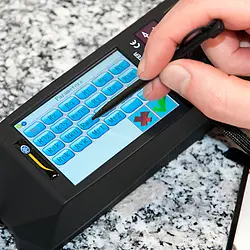
– Touchscreen interface and PC connectivity
– Measurement of all roughness values
– Battery and mains operation
– Different filters adjustable
– Diamond test head
– Removable motorized sensor
– Large measuring range: Rz: 0.02 μm … 320 μm; Ra, Rq: 0.005 μm … 32 μm


